


How to Get Cited by AI Search in 2026: A Practical GEO Playbook for Small Businesses
By Juyel Rana · November 4, 2026 · Updated November 4, 2026
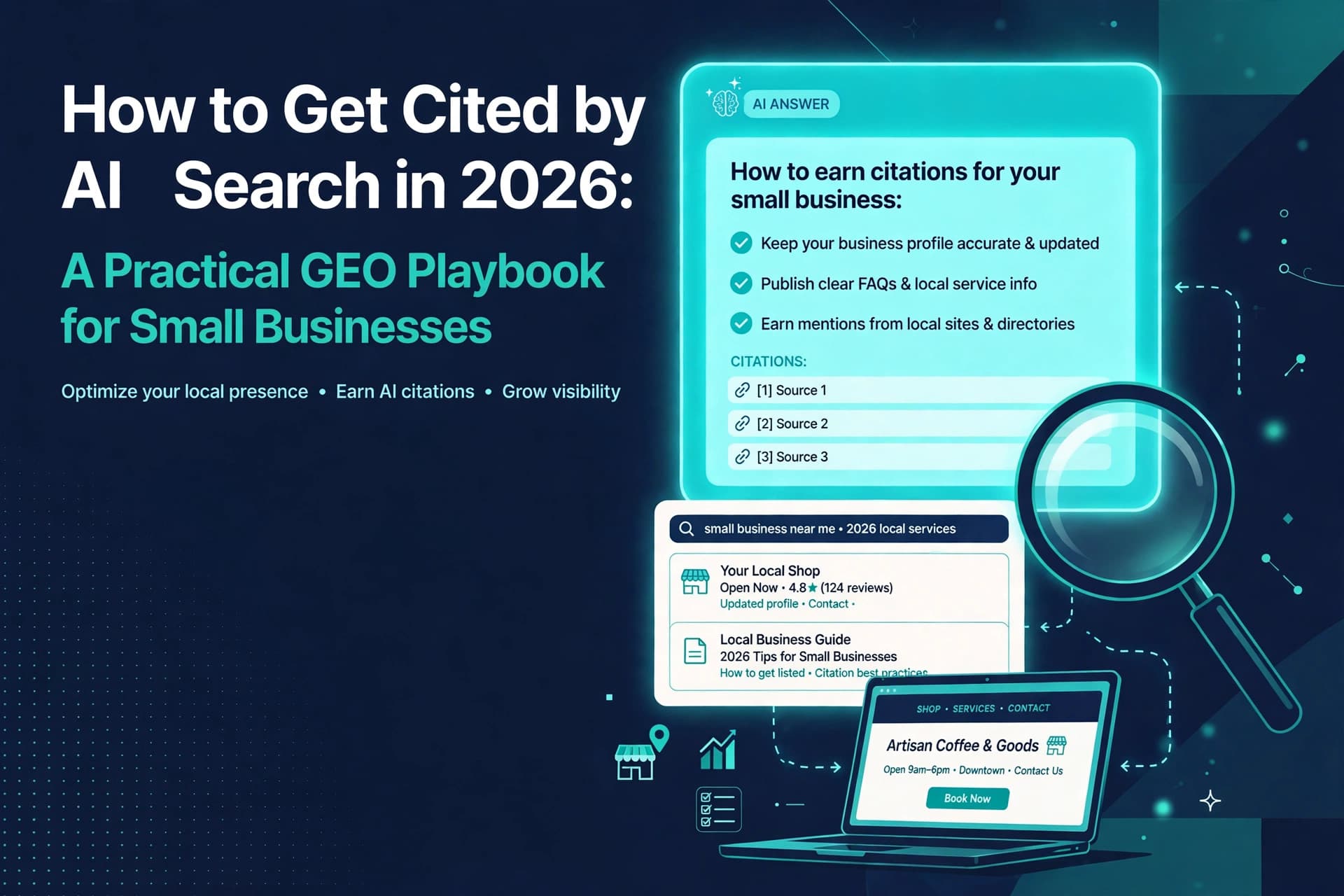
Search is no longer just ten blue links. Google AI Overviews and AI Mode, ChatGPT Search, and Perplexity now answer many questions directly, and only then show sources. That changes the goal for a small business: you are not only trying to rank, you are trying to be one of the sources an AI answer is built from.
This is not a reason to panic, and it is not a reason to buy a new magic tool. The research so far points to a simpler conclusion: clear, credible, well-structured pages still win, but the way you measure success has to change.
Why clicks are falling, and why citations matter more
Multiple independent studies in 2025 and 2026 found the same pattern: when an AI Overview appears, fewer people click a traditional result. Pew Research found users clicked a traditional result in 8% of visits with an AI summary, compared with 15% without one. Ahrefs found a 58% lower click-through rate for the top-ranking page on queries that trigger an overview. Chartbeat reported Google Search referrals to news sites fell 40.2% between July 2025 and July 2026, with smaller publishers hit hardest.
Those figures vary by query type and study, so treat them as directional, not as a prediction for your site. The important shift is this: informational clicks are becoming harder to win, while decision-stage clicks are more valuable. Seer Interactive found that being cited in an AI Overview was associated with about 120% more organic clicks per impression than not being cited on the same results page.
In other words, the citation itself is now part of the traffic. If you are not in the answer, you may not get the click at all.
What Google actually says
Google has been clear, and its guidance is reassuring for small businesses. To be eligible as a supporting link in AI Overviews and AI Mode, a page must be indexed and eligible to be shown in Google Search with a snippet. Google says there are no additional requirements, and that normal SEO fundamentals remain relevant.
That means you do not need a separate AI SEO strategy. You need the same fundamentals, applied with more focus on clarity and evidence. It also means claims about special AI files or schema as a shortcut should be treated with care. Google says llms.txt and AI-specific markup are not needed, and Ahrefs testing in 2026 found no meaningful citation uplift from schema alone.
How AI engines choose what to cite
Different engines use different indexes, but they share a pattern: they retrieve a short list of pages, extract the clearest facts, and write an answer from those sources. Many AI answers cite only two to seven sources per response, so the competition is for a very small number of slots.
Three things consistently help a page make that short list:
- A self-contained answer. A short paragraph that directly answers one specific question, without needing the rest of the page to make sense. Researchers call this an answer capsule.
- Evidence, not superlatives. The foundational GEO study from KDD 2024, by researchers from Princeton, Georgia Tech, the Allen Institute for AI, and IIT Delhi, found that adding citations, relevant quotations, and statistics improved visibility in generative answers by roughly 30 to 40%. Keyword stuffing did not perform well.
- Corroboration elsewhere. AI tools are more willing to name a business that several independent sources describe the same way. Your own site, your Google Business Profile, reviews, directories, and earned mentions together form a fact. One self-made claim alone is just a brochure.
Earned media matters here. One analysis of shopping citations in Q2 2026 found 41% came from retailers, 37% from earned media, 15% from brand websites, and 7% from user content. Your own site is important, but it is not the only place AI looks.
Step 1: Let the right crawlers in
A page a crawler cannot reach cannot be cited, however good it is. Check these first:
- Googlebot for Google AI Overviews and AI Mode
- OAI-SearchBot for ChatGPT Search, not GPTBot, which is for training
- PerplexityBot for Perplexity
Check your robots.txt, and also check your CDN or firewall bot settings, which can block a crawler even if robots.txt allows it. Make sure key pages are server-rendered and readable without JavaScript, because some AI crawlers do not execute JavaScript reliably.
Step 2: Build one answer-first page per question
Do not write one long page that tries to answer everything. Write one focused page per buyer question, with the direct answer in the first one or two sentences.
Use the question in natural language, the way a customer would ask it in a chat: "How much does local SEO cost?" rather than "Pricing Overview." Use short paragraphs, descriptive headings, and comparison tables where they help. Add a FAQ section for follow-up questions, but keep each answer self-contained.
A good test: if you copy just the first paragraph, does it still answer the question? If not, move the answer up.
Step 3: Add checkable facts
AI systems favour content they can verify. On priority pages, add:
- Specific prices, ranges, or what affects price
- Specific specifications, timelines, and service areas
- A relevant statistic, with its source linked
- A short, attributed quotation, where appropriate
Keep claims narrow and defensible. A specific claim you can back up beats a broad claim you cannot. Avoid vague superlatives like "industry-leading" with no evidence behind them.
Step 4: Earn mentions where AI already looks
For local and service businesses, this is often the highest-leverage step. Keep your Google Business Profile complete and consistent, including category, service area, hours, and description. Ask for reviews, reply to them, and keep your name, address, and phone number identical across directories.
Also aim for mentions in places AI engines already cite: local news, industry publications, chambers, associations, and trusted directories. You do not need dozens. A few credible, consistent mentions that describe your service the same way are more useful than a large number of low-quality links.
Step 5: Measure citations as a frequency, not a yes or no
AI answers are sampled, not looked up. Asking the same question twice can return different sources and different brands. Research from SparkToro and Gumshoe in January 2026 found that asking the same brand question many times rarely returned the same brand list.
So do not judge GEO from one answer. Build a list of 20 to 50 real buyer questions, sorted by funnel stage: learning, comparison, and buying. Run each prompt three times per engine, in a clean session, and record whether you were cited, mentioned without a link, or absent. Track that frequency monthly.
In Google Search Console, use the Generative AI performance report, rolled out to all sites on August 31, 2026, to see how often your links appeared in AI Overviews and AI Mode. Note its limit: it shows impressions only, not clicks or queries. For clicks, compare pages and queries that appear in AI features with similar pages that do not, over the same period.
What not to do
- Do not create a page for every possible variation of a question. Google says scaled content abuse applies to AI responses too.
- Do not rely on llms.txt, schema, or a new file as a citation trick. Use schema to help machines understand your page, not as a replacement for good content.
- Do not publish AI-generated content without a human fact-check. Google tightened its guidance in October 2026 to say manual review should cover titles, meta descriptions, structured data, and image alt text, not just body copy.
- Do not chase a single AI rank. Citation is variable, so a one-time win is not a strategy.
A 30-day starter plan
Week 1: Access and facts. Check robots.txt and firewall rules, fix Google Business Profile consistency, and list your top 30 buyer questions.
Week 2: Answer-first rewrites. Rewrite your five highest-traffic service and FAQ pages with a direct answer at the top, plus one checkable fact each.
Week 3: Corroboration. Request reviews, update directories, and pitch one useful local or industry mention.
Week 4: Measure. Run your prompt list three times per engine, record citation frequency, and check Search Console for AI impressions. Fix the biggest gaps first, then repeat.
The bottom line
GEO does not replace SEO. It adds a citation layer on top of it. A page still has to be crawlable, indexed, and useful before an AI engine can use it. The businesses that win citations in 2026 are not the ones with the biggest budgets. They are the ones with the clearest answers, the most checkable facts, and the most consistent presence across the web.
Start with one question, one clear answer, and one piece of evidence. Then measure, and do it again.
Keep reading on heyjuyel.com
- Ads Are Moving Into AI Assistants, and Martech Is Scrambling - how AI assistants are becoming ad and transaction surfaces, and why citation matters more than a click alone.
- 35 Modern SEO Hacks for AI Overviews and LLM Citations in 2026 - practical tactics for AI Overviews and LLM citations.
- The Zero Click KPI Set for 2026 - how to measure success when fewer searches end in a click.
- Gartner AI Budgets Hit 15.3% of Marketing Spend, Readiness Is Lagging - why AI budgets are rising faster than readiness.
- Google Search Essentials Formalizes AI Content and Spam Rules - the content and spam rules that also apply to AI answers.
Sources and further reading
- AI Search in August: Google Expands AI Overviews as Clicks Fall
- AI Overviews and your clicks: how to measure the impact in Search Console
- AI Overviews vs AI Mode: What Each One Changes for Your Website
- Generative Engine Optimization: Enterprise GEO Guide
- Generative Engine Optimization: A Small-Brand Playbook
- How to Get Your Business Cited by ChatGPT and Perplexity
- Get Cited by AI Search Engines: 8-Step Startup Checklist